The ad layer for GenAI apps

95% of your GenAI users will never subscribe.Monetize your free tier with wavebird's SDK.

You're building an app, not an ad platform.

One integration.
Programmatic demand.
wavebird connects your app to the ad market through established programmatic standards. Billing, proof, and rollout controls sit in the infrastructure layer. You keep the product surface. wavebird handles the ad path.
Rollout stays with you.
Start with one surface, allow only banner or video, and block industries that do not fit your product. You go live step by step instead of rebuilding ad tech.
Model stays
separate.
The ad path runs separately from the model path, in parallel to your app. That lets you monetize usage without rewiring answer logic or UX.
Your UX,
your setup.
Run ads before, during, or after inference. Choose the slot, the format, and the behavior. Monetize usage without hijacking the session, compromising trust, or pulling users away from the product they came for.

AN OPEN STANDARD

Compute Sponsoring v1.0The first standard for Ads in GenAI.

Compute Sponsoring v1.0 is the open standard behind wavebird. It defines how sponsored placements can fund AI compute without touching the model. It keeps consent, proof, and delivery behavior legible across implementations.

We don'ttouch your model.

Here's what happens when your app sends a prompt.

Your user sends a prompt
Your app handles the API call as usual.
Data is filtered before it leaves
You decide which signals may leave your system for ad matching (for example topic category and language). Everything else is blocked by default.
you control egress
An ad is matched while the model thinks
Decisioning runs during the existing inference wait window. Timing sources are published as engineering evidence.
15.28ms until an ad can be placed
The ad is delivered and proven
Your app renders the placement. wavebird emits proof events so delivery is independently auditable.
Automated proof per impression
Your user sees the response
Your UI renders the model response and the placement based on the rules you configure.

Built on Compute Sponsoring v1.0.

Turn every free prompt into revenue.

Slide to see what your free tier could earn.

500,000
YOUR COST
-$2,500
Your API cost per month
At $0.005 per prompt avg.
ONE AD BRINGS
+$4,750
Ad revenue per month
At CPM $9.50, programmatic avg.
YOUR PROFIT
+$2,250
Estimated net gain after compute
Your free tier can pay for itself

API cost assumes roughly 900 tokens per prompt and uses the public pricing pages from OpenAI and Anthropic.
CPM uses the Programmatic Transparency Benchmark Q3 2025.

See it live. Right now.

This is chat.wavebird.ai - a live GenAI app running wavebird's ad layer.See how ad formats appear to end users.

Try it live

Ad Banner

Appears above the chat, clearly labeled as ad. In the default inference-time setup, it clears when the response arrives.

Ad Clip

A short clip plays in the configured ad slot. Non-intrusive, skippable, and fully verified by wavebird.

Three steps. Any app.

wavebird works with any

chat app, coding assistant, vertical copilot, or consumer AI app.

// Connect wavebird to your GenAI app

Step 1

Connect

One SDK and a small configuration surface. Start with Node direct in the SDK documentation. The tested browser entry and proxy compatibility come after that.

Step 2

Configure

Set data policy, ad formats, blocked industries. wavebird enforces your rules on every prompt.

Step 3

Earn

wavebird handles delivery, proof, and settlement. You get paid per verified impression.

The team behind wavebird.

Many build their products with GenAI,but don't ask themselves how to finance it. We do.
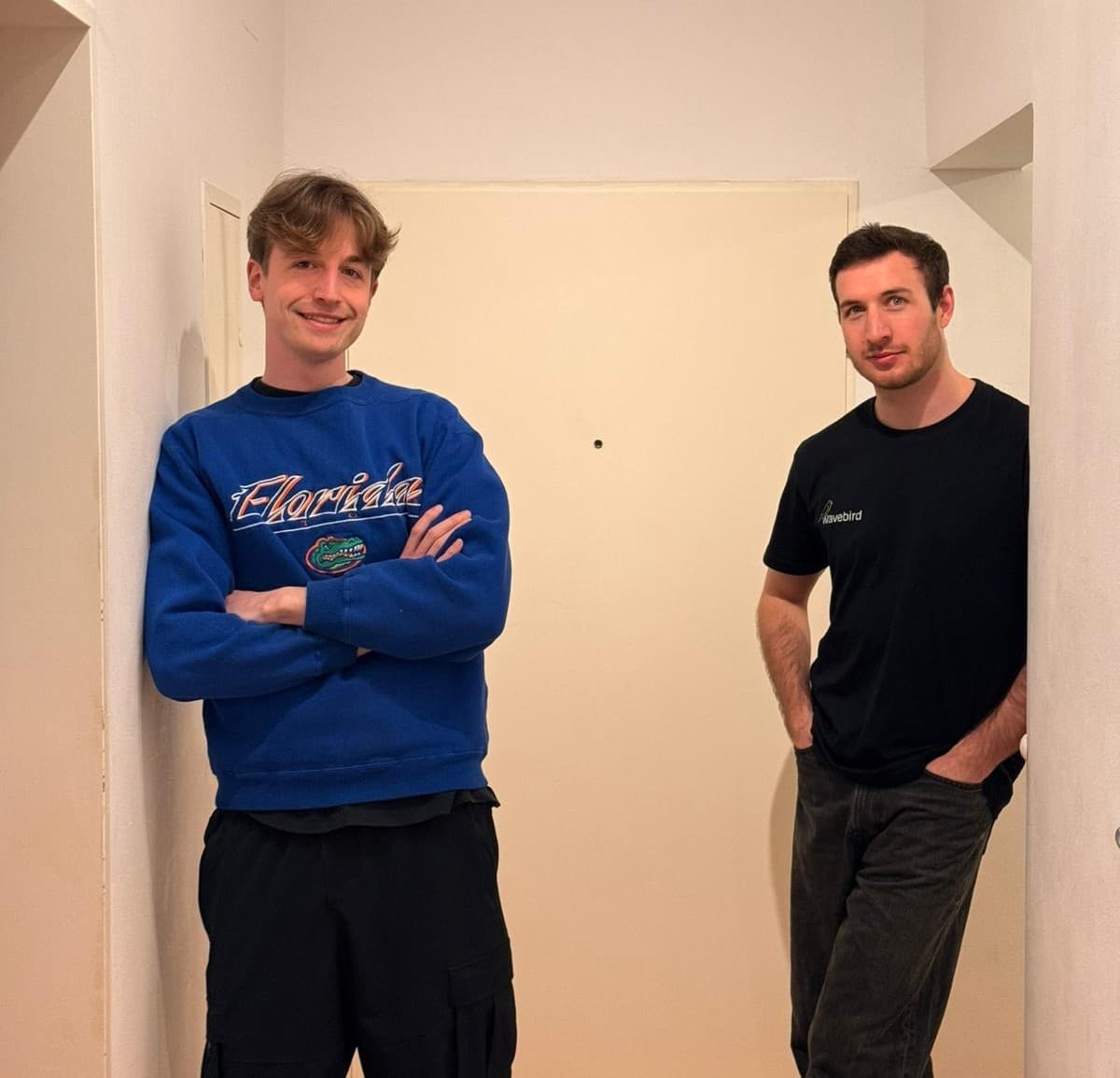
Mario von Bassen and Constantin Keller, founders of wavebird

Mario von Bassen

CEO & Technical Lead

LinkedIn

TU Wien (Visual Computing, M.Sc.) and B.Sc. in E-Commerce. Years of hands-on work in software security, decentralized systems, and IT infrastructure. Then built the entire wavebird stack alone: privacy firewall, proof engine, SSP connector, and SDK.

Constantin Keller

Commercial Lead

LinkedIn

TU Darmstadt (Industrial Engineering, M.Sc.). Sales & strategy at Bosch, before early commercial team at Tvarit (AI/manufacturing). Bridges enterprise ad buyers and app teams - knows how both sides think.

Frequently asked questions

Roughly $0.0095 per prompt at current ad market rates. Outside the dedicated economics guide we keep this to the short version. The full calculation lives in the Free tier economics guide.
No extra roundtrip is added in the recommended path. Your model call and wavebird run in parallel, and internal measurements put ad matching under 20 ms. The full timing model is documented in How wavebird works.
Not in the default integration. The model request runs as usual and the sponsored placement is rendered separately by your app. If you choose a tighter product integration, that is an explicit app decision rather than a hidden side effect of the ad system.
That depends on the profile you configure, but the standard path shares only broad topic category and language for matching. Raw prompt text, conversation history, and personal data do not need to leave the app in the default setup. The filtering path is described in the data firewall.
Yes. Formats, blocked industries, relevance mode, and no-fill behavior are app-side configuration decisions. wavebird handles market access while product-facing rules stay with your team.
On your side, you integrate the SDK and define rules for data, formats, and blocking. wavebird prepares the OpenRTB path, handles proof and billing, and is completing the first live SSP connection before broader exchange rollout.
Compute Sponsoring turns the model wait window into a clearly labeled revenue moment. A brand can sponsor the compute behind the response while your app keeps control over timing, formats, and disclosure.